
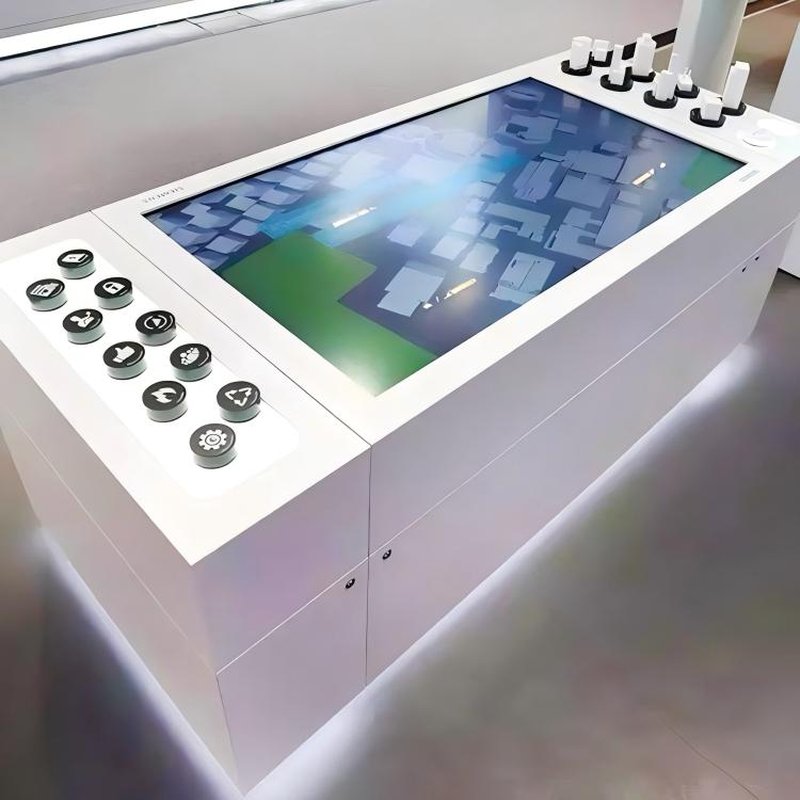
Deploying a commercial-grade Interactive Go Game Touch Table provides interactive venues with an advanced digital display platform. An interactive Go touch table is an intelligent device that merges the ancient board game of Go with modern interactive touch display technology. Its core functionalities encompass chessboard interaction, stone placement recognition, game recording, and real-time visual feedback. By pairing responsive touch displays with intelligent Go software, traditional board gameplay is transformed into an engaging digital experience. Understanding its operating mechanism requires examining how infrared (IR) and projected capacitive (PCAP) touch technologies detect input and how their principles shape the user experience.
1. Operating Principles of Infrared and Capacitive Touch Technologies with a Interactive Go Game Touch Table
Infrared and capacitive touchscreens represent the two predominant interactive technologies in digital tabletop design, differing significantly in their detection mechanisms, input media, and operational characteristics.
Infrared touchscreens deploy an array of infrared light-emitting diodes (LEDs) and phototransistors around the perimeter bezel of the screen, creating an invisible, dense grid of intersecting infrared beams. When a finger or physical object touches the surface, it interrupts specific light beams. The internal controller calculates the coordinates of the obstruction to determine touch location. Because optical interruption does not rely on electrical conductivity, IR screens register inputs from fingers, styluses, gloves, and non-conductive physical objects meeting geometric thresholds.
Capacitive touchscreens (notably Projected Capacitive Touch, or PCAP) detect touch coordinates by measuring minute variations in electrostatic capacitance across an embedded conductive grid on the glass surface. PCAP touchscreens offer ultra-high sensitivity, exceptional optical clarity, and robust multi-touch capabilities, making them the preferred choice for fluid multi-finger gestures, pinch-to-zoom, and multi-user interactions. However, touch registration relies on the conductive properties of the human body; standard non-conductive plastic or stone game pieces cannot naturally trigger a capacitive response.
2. Key Differences in Interactive Go Table Applications
When applied to interactive Go touch tables, both infrared and capacitive technologies present unique architectural trade-offs. The optimal selection hinges on stone interaction methods, usage frequency, and structural design.
The primary advantage of infrared touch lies in its broad input media compatibility. Because the sensing elements reside in the bezel frame rather than relying on surface electrical charges, IR tables readily detect both fingers and properly dimensioned physical stones. However, the dustproof and waterproof integrity of the table depends on the overall chassis sealing and structural engineering, rather than the touch technology alone.
Capacitive touch delivers superior responsiveness, a sleek edge-to-edge pure-flat glass aesthetic, and micro-precision suitable for fine stone placement, menu navigation, and multi-touch shortcuts. However, if the Go table design requires physical playing stones, the product must incorporate specialized conductive tokens, smart chips, or dedicated sensor modules. Standard off-the-shelf capacitive screens cannot register conventional non-conductive stones.
Consequently, infrared touch is well suited for designs demanding flexible physical input compatibility, while capacitive touch excels in pure-glass, high-precision finger-based and multi-touch interactions. Overall performance is further refined by touch controllers, LCD panel quality, and game software algorithms.
3. Selecting the Right Touch Technology Based on Application Scenarios
In high-traffic commercial arcades, cultural centers, youth clubs, and public educational venues, interactive Go tables face rigorous, continuous daily use. Key selection criteria should prioritize touch stability, surface tempered glass impact resistance, structural durability, ease of sanitization, and software stability. If physical stones are utilized, verifying stone recognition accuracy and algorithm matching is paramount.
For home recreation, VIP private clubs, boutique teahouses, and interactive digital exhibits, users prioritize display aesthetics, rapid touch response, multi-point fluency, and intuitive UI ergonomics. In such settings, capacitive technology often delivers a more refined, luxurious, smartphone-like touch experience.
Moreover, the underlying LCD display unit plays an equally critical role. Panel brightness, contrast ratio, wide viewing angles, and refresh rates directly impact the legibility of grid lines, stone rendering, and animated gameplay cues. While touch technology determines how moves are captured, visual clarity and software execution determine how the game is experienced.
4. ZXTLCD Interactive Go Touch Table Solutions
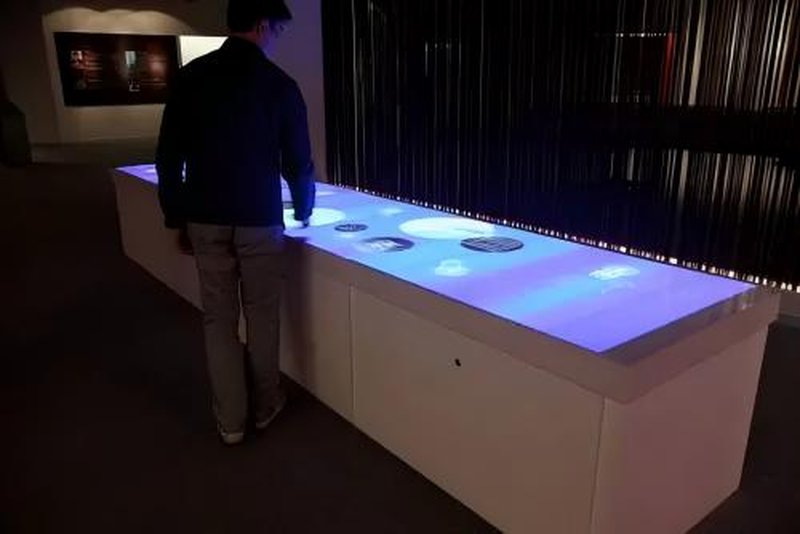
ZXTLCD designs tailored interactive Go touch table solutions to satisfy diverse commercial, educational, and leisure demands. Engineering plans comprehensively balance display diagonal size, touch sensing technology, piece recognition methodology, interactive Go software, visual performance, and ergonomic chassis construction.
For touch-only interactive Go tables operated exclusively by fingers, ZXTLCD emphasizes ultra-low latency touch response, pixel-accurate stone snapping, and responsive multi-touch interaction. For hybrid models utilizing physical stones, engineering teams prioritize specialized piece sensing and deep integration with game rules engines. Furthermore, units intended for public environments incorporate anti-scratch tempered glass, robust all-metal enclosures, and low-maintenance architectural designs.
The true value of an interactive Go touch table extends far beyond rendering a digital grid on glass—it creates a harmonious loop of precise touch detection, game logic processing, and immersive visual-audio feedback. Deciding between infrared and capacitive touch technologies based on target operational scenarios unlocks the full interactive potential of modernized Go culture. In conclusion, adopting a professional Interactive Go Game Touch Table enhances presentation capabilities, engages multi-user audiences, and drives digital transformation.
Looking for customized Interactive Go Game Touch Table hardware, multi-touch interactive tables, or OEM/ODM commercial display solutions? Feel free to contact the ZXTLCD engineering team for free consultations, product demos, and tailored technical specifications.